

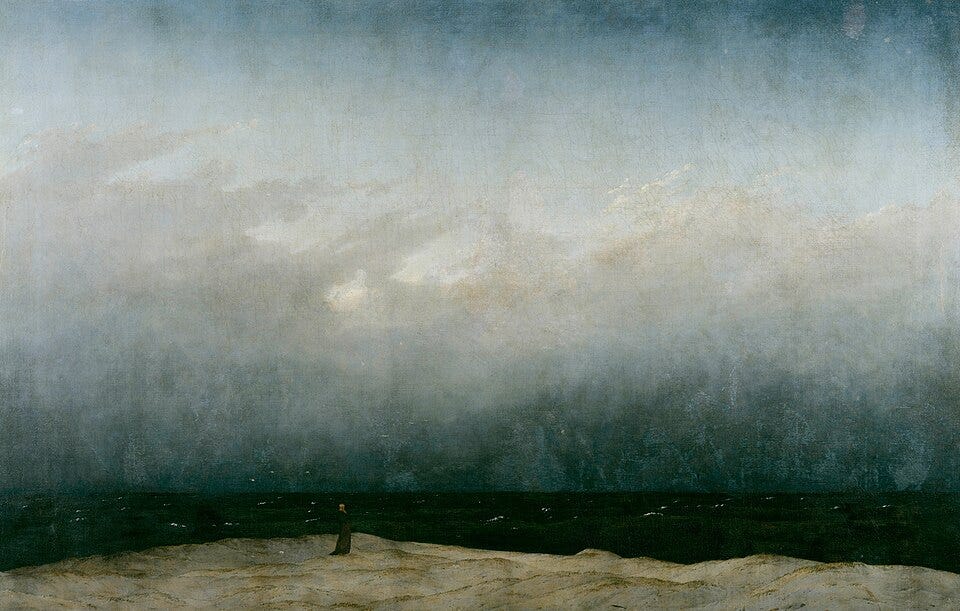
Part I—Ash.
ἀνάγκᾳ δ᾽ οὐδὲ θεοὶ μάχονται.
“Not even the gods contend with necessity.”
He had written it that way three times.
Then crossed out necessity.
Then written it again, as if repetition might domesticate it.
Caleb let the word remain, suspended at the end of the sentence, the cursor blinking after it with small mechanical patience, like an eye that refused to close. Outside the narrow apartment window, the Pacific lay flat and metallic beneath a winter sky drained of ornament. Fishing boats moved near the breakwater with the slow, indifferent drift of objects untethered from urgency, their hulls reduced to dark strokes against the gray. The air that entered through the slight crack in the frame carried the mingled scent of salt and engine oil. He had been in this town long enough now that the gulls no longer startled him awake; their cries had been absorbed into the grammar of morning.
Not even the gods contend with necessity.
The Greek itself was unadorned, almost austere in its clarity. It yielded without resistance to the eye, to the trained habit of parsing case and tense. It was the English that would not settle. Anankē did not mean fate, not precisely; fate implied narrative, a sequence unfolding toward an end already inscribed. Nor destiny, which carried too much human heat. Nor compulsion, which suggested interior motive rather than exterior pressure. It was something less dramatic and more severe—a force that pressed inward from all directions at once, indifferent to preference or protest. A condition rather than an event. A fact before which argument felt not merely futile but theatrical, like raising one’s voice in a room already sealed.
He deleted the line again.
“Even the gods do not struggle against what must be.”
Too weak.
He leaned back in his chair and pressed the heel of his hand into his eye until a brief scatter of light flared behind the darkness there, then faded. The apartment held its weekday silence, the particular coastal quiet that did not feel empty but suspended, as if the day had not yet committed itself, no rush of traffic, only the intermittent whine of a scooter passing below and the patient hum of the refrigerator cycling on and off. The rooms were arranged with practical restraint: a compact kitchen opening into the single main space, a sliding partition that suggested privacy without insisting upon it.
The walls, an undecided white, absorbed the metallic morning light that entered through the narrow window facing the harbor, where a disciplined strip of sea lay flat beneath the winter sky. On the wooden table before him, serving indiscriminately as desk and dining surface, rested his laptop, a mug gone cold, and a thin paperback copy of Antigone, its margins penciled in two languages, the notes moving in tight, controlled script along the edges as if argument itself could be contained by narrow borders.
He had furnished the place without ambition. Two mismatched chairs faced one another across the table in a manner that implied use rather than hospitality. At night he unrolled a futon onto the tatami in the corner and in the morning folded it away again into the closet, restoring the room to its daylight austerity, as though sleep were an indulgence that required erasure. Across from him, beneath the window, a low shelf held an electric kettle, folded linens stacked with almost monastic care, and the cedar box he had purchased at an inland market during his second month here.
The vendor had told him the wood came from the north, from older forests where the grain grew tight and straight; Caleb had run his thumb along its lid as if testing the truth of that claim. When lifted, the scent rose immediately—clean, resinous, almost sweet—momentarily overpowering the faint salt that drifted in through the cracked window. The box contained nothing. Yet it seemed the most substantial object in the room, as though the emptiness it guarded were not absence but a form of preservation, something kept intact by being left untouched.
He kept nothing in the box.
The cursor blinked.
He typed again:
“Not even the gods fight against what presses upon them.”
Better.
Not elegant, but closer.
He saved the document and stood, drawing his arms upward and back until the stiffness gathered between his shoulders loosened with a faint, reluctant ache. The room had grown cooler while he sat, the morning light thinning against the window. The tremor, when it came, entered so discreetly he mistook it at first for the vibration of a truck passing along the harbor road below. The glass in the window gave a quick, uncertain rattle, like teeth striking once against cold. Then a narrow shiver traveled through the floorboards and rose into his body, up through the soles of his feet and along his calves, delicate as a pulse taken at the wrist, so slight it seemed almost imagined, yet unmistakably external.
He froze, his breath held without instruction. The hanging light above the table traced a small arc in the air—once, twice—its chain ticking softly against the metal fixture before settling back into stillness. The futon closet door gave a faint click within its frame. Outside, nothing altered its course: the boats beyond the window continued their slow and indifferent drift across the gray water; the sky held its color; a gull tilted and corrected itself against the wind. Somewhere down the street a dog barked, sharp and singular, then stopped as if embarrassed by its own alarm. Caleb remained standing in the center of the room, suspended between movement and restraint, listening for what might follow.
He counted without meaning to. One. Two. Three. Four.
Nothing followed.
He released the breath without knowing he had gathered it, the air leaving him in a thin, controlled stream, and told himself, as he had told himself before, that this was ordinary here. The peninsula lived with such motions the way Oklahoma had lived with sirens: not as spectacle but as background, an accompaniment to breakfast tables and school mornings and the slow choreography of daily errands. You learned the scale. You learned which tremors were throat-clearing and which were declarations. You learned what required the doorway and what required only patience. You learned, above all, to distinguish rehearsal from event.
Still, his hands felt hollow, as though something small and essential had been scooped from the center of them. A faint tremor lingered there, not in the floor now but in the blood. He crossed the room and placed his palm flat against the wall, an old and involuntary gesture, as if checking for heat behind plaster, for the hidden evidence of combustion. The surface was cool, faintly textured beneath his skin. He kept his hand there a moment longer than necessary, feeling the steadiness of it, the stubborn neutrality of painted gypsum and timber, until the ordinary silence of the apartment returned and held.
“It was nothing,” he said aloud, testing the sound of his voice in the small space.
His phone buzzed on the table. A message from Kenji.
Did you feel that? Small. Offshore.
Caleb typed back: Yes. Hardly anything.
Three dots appeared almost immediately.
Good practice, Kenji wrote. The earth clears its throat.
Caleb stared at the phrase on his screen until the letters seemed to separate from one another, no longer a sentence but a procession of shapes requiring allegiance. He pictured Kenji in his university office overlooking the harbor; the wide window half-cracked despite the cold, papers arranged in precise vertical columns across the desk, each stack an argument awaiting its hour. The kettle would already be filled, resting on its small electric coil, prepared for the disciplined comfort of afternoon tea. Kenji possessed the rare ability to render even seismic disturbance polite, to describe the earth’s convulsion as though it had offered advance notice and regretted the inconvenience. The earth clears its throat, he had written, and Caleb could almost hear the gentle humor beneath it.
He returned to the desk and lowered himself into the chair, the wood giving a small answering creak. The Greek line waited with an austerity that felt nearly moral.
Not even the gods contend with necessity.
He considered the word again in Japanese, turning it as one turns a stone in the hand. Hitsuyō approached it from the side of usefulness, something required for a purpose, a tool summoned by circumstance; it lacked severity. Unmei wandered too far toward destiny, scented faintly with romance and fatalism. Neither held the stern compression of the original, the sense of pressure applied from all directions at once, of a force that did not negotiate and did not require belief.
Anankē was not story and not plan. It was the narrowing of options. It was the fact before which rhetoric felt theatrical. He could feel, beneath the problem of translation, the older problem pressing upward—the human need to name what carries us, and the equal need to believe that naming it might soften its grip.
He opened a new document and typed the word alone:
ANANKĒ
It stood there in capital letters, severe and unaccompanied, the diacritic arcing over the final vowel like a held breath. Beneath it he began to assemble its possible English bodies, setting them down one by one as though testing vessels for seaworthiness.
Necessity.
Constraint.
Compulsion.
Force.
What must be borne.
He paused at the last.
What must be borne.
The phrase seemed less abstract than the others, less armored. It bent slightly under its own weight. The tremor had been small; he knew this with the part of his mind that read data and trusted instruments. There would be no alerts scrolling across screens, no sirens splitting the morning, no official voice advising caution. At most, a notation in some geological ledger, a line among thousands marking a brief rearrangement of stress beneath the sea. And yet the body did not consult records before it answered. The body remembered its instructions without translation. It tightened. It counted. It prepared.
He stood again, unable to remain seated within the narrow perimeter of the desk, and crossed to the shelf beneath the window. The cedar box waited where he had left it, its lid fitted so precisely it seemed grown rather than constructed. He lifted it and opened it.
The scent rose at once—sharp, clean, resinous—filling the small room with the suggestion of distance and altitude, of forests that had not been cut into planks and measured into rent.
For a moment the apartment receded, its white walls and harbor light dissolving as though drawn back behind a scrim.
He was standing in a hallway lined with doors, identical and closed. The air thickened with a sweetness that soured even as he breathed it, turning acrid at the back of his throat. Somewhere a voice called his name, from behind him, or ahead; he could not tell. The sound seemed to arrive without direction. The light had altered, taken on a bruised and wavering cast, and the ceiling above him moved; not visibly, not in any way that could be charted, but with the slow inhalation of smoke gathering where it should not gather, breathing where no breath should be.
He shut the lid.
In his early thirties, Caleb carried himself with the curious mixture of youth and premature gravity that comes to those who have outlived something foundational. At six foot one he seemed taller when standing still than when walking, as though motion required a small concession to the weight of memory. The stoop in his shoulders was not pronounced, but habitual; the posture of a man long bent over books and notebooks, over arguments carefully drafted and redrafted. Dark auburn hair refused discipline, falling forward despite his efforts to keep it orderly, softening what might otherwise have been an austere face. His gray-blue eyes, nearly colorless in unforgiving light, gave him an expression of watchfulness rather than ease.
Clean shaven, he appeared younger at first glance than he felt, until one noticed the steadiness in his gaze. His hands were large and deliberate in movement, more accustomed now to turning pages than shaping wood. Along his left forearm lay a faint burn scar, pale and almost imperceptible, but mapped in his mind with cartographic precision. He moved through the world as if anticipating a sudden rupture, each step measured, each doorway entered with unconscious caution.
There was in him an intellectual discipline honed past the vanity of display; he believed language could hold disorder at bay, that a sentence honestly constructed might resist the entropy that consumed less examined things. Remembering the dead was, to him, not sentiment but obligation; a sacred duty against erasure. Yet he guarded his interior life carefully, articulating his deepest thoughts only in solitude, in margins and notebooks where he subjected himself to rigorous moral self-interrogation.
He replayed conversations after they ended, scanning for failures of courage, for imprecision, for any harm done by silence or excess. Emotionally avoidant in practice but fiercely loyal in conviction, he loved with endurance rather than ease, holding to people the way one holds to a promise, quietly, absolutely, and at cost.
The apartment returned to him by degrees: gray sky pressed flat against the window, the harbor lying metallic and undisturbed, the faint ticking of the cooling radiator contracting within the wall. The air seemed thinner than before, rinsed clean of the cedar’s sweetness. In the glass he caught his own reflection superimposed upon the water—face narrowed by the angle of light, shoulders slightly drawn forward, a figure both present and already receding. He looked thinner than he remembered from photographs taken years earlier, though perhaps it was only this coastal light, which refused drama and stripped the body to its outline.
He set the box carefully back upon the shelf and returned to the desk, lowering himself into the chair with deliberate quiet. On the screen, the Greek waited without impatience, neither accusing nor absolving.
Not even the gods contend with necessity.
He deleted the line again, the erasure clean and momentary, and began to type:
“Not even the gods wrestle with what must be borne.”
He read it aloud, testing its balance in the air of the room. The word borne settled differently in his mouth than necessity. It carried weight; it suggested shoulders beneath it, a back inclined, a body consenting not by choice but by endurance. It implied a carrier. He did not yet know whether he preferred it, whether it clarified or merely consoled.
Outside, a gull dropped abruptly from the sky and rose again, banking against the wind with a single sharp correction. The sea remained level and inscrutable, offering no commentary. His phone buzzed across the table, the sound abrupt in the quiet.
Coffee later? Kenji wrote. We should discuss the Heike passage.
Caleb looked back at the line on the screen, at the word he had chosen and not chosen, feeling its gravity without resolution.
Yes, he typed. I’ll bring the draft.
He saved the document. For a long moment he did not move. The tremor had passed; the light fixture hung motionless; the refrigerator resumed its low and dutiful hum. The world, as far as instruments could determine, remained intact.
Not even the gods wrestle with what must be borne.
He closed the laptop. The cursor vanished into black, but the sentence persisted, not on the screen now but somewhere interior, steady and unblinking.
Love it I’m excited to read more !!
Looking forward to reading the next chapter