

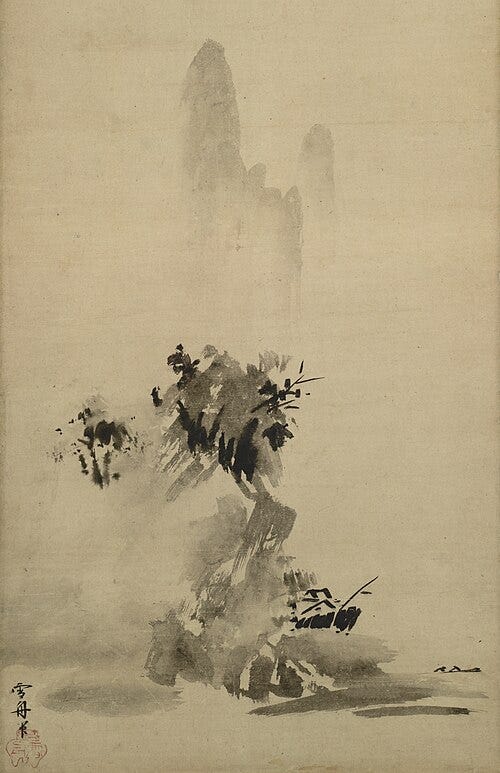
世間の
繁き刈廬に
住み住みて
至らむ国の
たづき知らずも
— 万葉集 第16巻 3850番歌
In this worldly life,
in a busy, crowded hut,
dwelling on and on,
I do not know the path
to the land I’ll reach at last.
— Man’yōshū, Book 16, Poem 3850
(translation by the author)
Red Clay County, Oklahoma — Spring 2006-Spring 2007
The elective appeared on the bulletin board in January, printed in thin black ink that trembled across the page as if uncertain of its own being, a hesitant thing, small and tentative, yet bearing the weight of choice and consequence in every letter, whispering to the watching eyes that here was a path, fragile and austere, and yet no less real for all its quietness, as if the world itself had paused to consider whether it had the right to offer it at all.
INTRODUCTION TO JAPANESE LANGUAGE AND CULTURE
Instructor: Mrs. Keiko Takahashi
Visiting Exchange Program
Meets 7th Period, Room 214
There were not many electives in Red Clay County. Woodshop. Agriculture Science. Journalism, when enrollment permitted. Spanish had been offered once every other year, depending on funding and whether they could find someone willing to drive in from Tulsa. Latin had vanished before Caleb entered high school; Daniel still spoke of it the way a man speaks of a species gone missing—regretful, faintly indignant, as though it might have survived had someone only tried harder.
Japanese appeared on the bulletin board without announcement, a single sheet of paper thumb-tacked between Driver’s Ed and a faded flyer for spring musical auditions. No explanation. No precedent. It seemed less like an option and more like an accident.
Caleb read the notice three times. The ink was slightly crooked, as if the printer had pulled the page at an angle. Introduction to Japanese I. Limited enrollment. He stood there long enough for two freshmen to brush past him, laughing. Then he walked away. He did not tell anyone he was considering it. Not Daniel. Not Evelyn. He carried the possibility privately, as if speaking it aloud might cause it to dissolve.
The fire had been five years prior. By outward measure, the house had been repaired, routines restored, neighbors reassured. The kitchen cabinets had been replaced in a different stain. The refrigerator no longer hummed with suspicion. Daniel attended faculty meetings and graded essays with his usual marginal precision, red ink measured and unsentimental. The hallway stood intact, painted a shade brighter than before—as though brightness itself could persuade memory to thin.
It did not.
The plaster lay smooth where the old crack had once run, but Caleb sometimes paused there anyway, palm hovering an inch from the wall, feeling for a seam that no longer showed. Yet something in Caleb had narrowed. At school he found himself standing slightly apart from his classmates, not by intention but by habit, as if proximity required a kind of permission he no longer presumed to have. When they spoke of the fire, they did so in the tone reserved for weather or roadside wrecks, something witnessed from a distance and folded quickly into anecdote.
“Man, that was crazy.”
“You’re lucky.”
“I heard the wiring just sparked.”
He nodded.
The word lucky moved through him without finding a place to rest. He had learned by then that people preferred survivals clean, bordered, instructive. They wanted spark, flame, rescue. They did not want the corridor that narrowed. They did not want the sound a roof makes when it decides.
So he nodded, offering them the version that fit in a sentence.
“Yeah,” he would say. “Faulty wiring.”
It was easier to let the cause stand in for the consequence. Easier to allow the event to be mechanical. Wiring could be replaced. Cabinets reinstalled. Hallways repainted brighter than before. What had narrowed in him did not show on blueprints.
It showed instead in the way he measured rooms before entering them. In the way he marked exits without thinking. In the quiet arithmetic of distance and air. He did not resent his classmates. He understood, in a distant and clear way, that their simplifications were a mercy toward themselves, but he no longer confused what made things easier to carry with what made them true.
Luck.
He carried the word like a coin that had no currency.
At night he lay awake, reconstructing the hallway in his mind. The angle of light. The distance between doors. The way Daniel’s voice had changed in that final call. He tried to sequence memory into order, but it refused alignment. There was always a gap—a hesitation he could not measure.
In February, guidance counselors began circulating enrollment forms for the following year. Caleb sat at the kitchen table filling in required courses with mechanical efficiency. English. Algebra II. U.S. History. Chemistry. Then came the line marked Elective. He wrote Japanese. He did not know why. Or rather, he knew but could not have articulated it without sounding absurd: the letters on the bulletin board had seemed unburned. They belonged to no hallway he had walked. They carried no scent of cedar.
That was sufficient.
At home that evening the house seemed quieter than it had any right to be, as though the shadows themselves had settled over the worn floorboards and the lingering scent of dinner, and Daniel sat at the table grading essays on The Odyssey, the lamp throwing a pale circle over the papers, over the scattered thoughts of children who had only begun to imagine what it meant to call a man “resourceful,” to weigh cunning alongside endurance, to see a life measured not only by victories but by the quiet toll exacted by years of wandering.
Caleb lingered near the doorway, hesitant, shifting from one foot to the other, the darkening evening pressing softly against him, a presence that could not be ignored yet demanded no claim.
“Dad,” he said, and the word trembled somewhere between asking and telling.
Daniel looked up, pen hovering, as though the act of writing itself had suspended judgment, as though the ink on the page held its own moral weight.
“I decided to take Japanese,” Caleb said, and it was a statement, a small defiance, a tracing of something new along the surface of his life.
“Japanese,” Daniel repeated slowly, savoring the unfamiliar sound, turning it over in the mouth, as one turns a coin to see both sides, as though by hearing it spoken aloud he might understand not the language but the impulse behind it.
“They’re offering it as an elective,” Caleb said, almost as an afterthought.
“I saw the notice,” Daniel said, and the words floated in the stillness, carrying no judgment, only recognition.
Silence, heavy and deliberate, stretching itself between them, a presence as tangible as the lamp, as real as the weight of the essays that lay waiting.
“Why Japanese?” Daniel asked finally, soft but precise, careful not to disturb the moment more than it already was.
Caleb considered the question. He traced the edge of the table with his eyes, traced the familiar marks in the wood and the margin notes, the evidence of a mind seeking order and meaning.
“It looks different,” he said at last, and in those words was something larger than explanation, a small revelation, a beginning of something unspoken but urgent.
Daniel studied him, noting the simplicity of the reason, noting how children sometimes touch the infinite in the plainest of statements. “That’s a reason,” he said, softly. “Different is a beginning.”
He returned to the grading, circling the word smart on a student’s paper and writing in the margin: Intelligence is not trickery alone. Consider perseverance. No further questions were asked. They were unnecessary. The moment had taken its own shape.
Caleb closed the doorway behind him eventually, carrying with him the quiet promise of that difference, the faint weight of a phrase that would linger longer than any single act of learning, longer than any essay, a seed of seeing differently that the evening had quietly planted in the soil of his mind.
Room 214 had once been a storage space, and though the school had attempted to persuade it otherwise, with desks, with a chalkboard, with the small ceremonies of learning, it retained the quiet stubbornness of its former life. The marks were there for anyone patient enough to notice: pale rectangles where shelves had been removed, the paint near the ceiling uneven and slightly bruised where metal brackets had once clung, as if the walls remembered weight. The smell too lingered faintly, a dry, papery odor that suggested boxes and forgotten inventories rather than children.
Above the chalkboard hung a world map, its corners curling and its center sagging so that the oceans bent gently inward, the continents seeming to drift closer together than the earth itself would ever allow. It hung crooked, though whether by accident or by the slow fatigue of its nail no one had bothered to decide. On the far wall there was a poster, bright in the way such things always are when placed against institutional paint, showing cherry blossoms arched over a narrow river. The petals were caught mid-fall, suspended in that fragile instant which, if one stared long enough, seemed to contain both motion and stillness: the certainty that they must fall, and the illusion that they might remain forever as they were.
Mrs. Takahashi stood at the front of the room as the students came in one by one, their footsteps uneven, their voices subdued by the first-day uncertainty that makes even the boldest children temporarily thoughtful. She was smaller than Caleb had imagined she would be. Yet there was nothing slight in the way she held herself; her posture was upright, almost deliberate, as though steadiness were something she practiced rather than possessed by nature. Her dark hair, cut bluntly at the line of her jaw, framed a face that seemed attentive even in stillness.
She wore a gray cardigan that had the quiet dignity of clothing chosen for usefulness rather than display, and in her arms she held a stack of thin workbooks pressed lightly against her chest. She watched the students take their seats with an expression that was not quite a smile and not quite scrutiny—something nearer to the patient curiosity with which one observes the beginning of a story whose ending, though inevitable in some distant sense, is still entirely unknown. Caleb noticed this before he realized that he had noticed it, and for a moment he felt the peculiar awareness that comes at the threshold of unfamiliar places: the sense that nothing remarkable had yet happened, and yet something had already begun.
“Good afternoon,” she said, her English careful yet unforced, as though each word had been weighed beforehand and found worthy of its place. “My name is Keiko Takahashi. Please call me Mrs. Takahashi, or Takahashi-sensei.”
She turned to the board and, with practiced strokes, wrote her name in kanji:
高橋恵子
A student raised his hand. “Um… how do we read that?”
She smiled slightly. “Good question. This is read Takahashi Keiko in Japanese order—family name first, given name second.”
She pointed to the first two characters. “高橋 is Takahashi. 高 means ‘tall’ or ‘high,’ and 橋 means ‘bridge.’”
Then she tapped the last two. “恵子 is Keiko. 恵 means ‘blessing,’ and 子 means ‘child,’ which is a common ending for girls’ names.”
“So,” she concluded, turning back to the class, “Takahashi Keiko… or in English order, Keiko Takahashi.”
The class, if one were inclined to count its small society with precision, consisted of twelve students. Yet the number alone did not describe them, for each had arrived by a path as particular as the faint marks left in the walls of the room itself. Some had chosen the course with a restless curiosity that had not yet attached itself to any definite object. Others had come because the machinery of scheduling had nudged them there when other doors were closed.
In the back two boys leaned together with the loose insolence of companions who believed themselves immune to seriousness, whispering and laughing softly at the prospect of learning what one of them called “ninja language.” A girl in the front row sat with a straight back and bright attention, having enrolled because she loved animated films whose bright voices had once carried unfamiliar syllables into her living room. The rest, most of them, in truth, sat somewhere between interest and resignation, as though waiting to see what kind of hour this would become.
Caleb took a seat near the window, where the pale afternoon light slipped through the glass in a narrow band and rested across the desks like something quiet and undecided.
Mrs. Takahashi turned to the chalkboard and wrote three characters.
あ い う
The chalk moved with a deliberateness that made each curve seem less like a mark than like the trace of a gesture completed long ago and merely remembered.
“These are called hiragana,” she said. “They are one of our writing systems. In Japanese, we do not use only one alphabet.”
She turned back to the class and allowed herself a small smile, noticing, as teachers do almost instinctively, the mixture of doubt, surprise, and calculation spreading across their faces.
“We have three.”
A murmur moved through the room, not loud but persistent, like wind passing over a field where nothing had expected to move.
Caleb felt something shift within him then. It was not excitement, exactly; excitement would have been too bright a word for it. Rather it resembled the faint loosening of a knot that one had not realized was there until it began, quietly, to give way. Three writing systems.
Until that moment English had seemed inevitable to him, the way a landscape appears inevitable to someone who has never left it. Twenty-six letters: the same shapes returning again and again, rearranged into words that seemed infinite yet were always built from the same narrow stock. The limitation had been so familiar it felt natural.
Yet three systems, three different ways of making language visible, suggested something else entirely. Not limitation, but abundance. Mrs. Takahashi spoke first of sounds rather than meanings. She pronounced the vowels slowly, each one clear and rounded, as though washing it free of whatever habits the students’ mouths might try to impose.
“A. I. U. E. O.”
Caleb repeated them softly to himself. The sounds felt unexpectedly clean in his mouth, unburdened by the strange histories that cling to English vowels—those hidden shifts and accidents that no one ever explains. Then came the consonants, arranged with a quiet order that seemed almost mathematical.
“Ka. Ki. Ku. Ke. Ko.”
He copied the characters carefully into his notebook, watching the chalk marks on the board and trying to imitate the strokes exactly: the angle, the curve, the slight lift where the line ended. They looked nothing like the words he knew. There were no familiar arches or scaffolds like the Roman letters that had filled every book he had ever opened.
These shapes seemed to belong to a different logic altogether, one that did not ask permission from anything he had learned before. They were not burned into him by years of repetition, not hardened by habit. They were simply new.
When the hour ended, Mrs. Takahashi gathered the workbooks and stood again before them. She bowed her head slightly, not ceremoniously, but with a small gravity that made the room grow quiet in response.
“Language is not only vocabulary,” she said. “It is a way of seeing. I hope you will see differently.”
The students began to rise, chairs scraping faintly against the floor. Caleb closed his notebook, his fingers lingering a moment on the page where the unfamiliar characters sat in careful rows.
Seeing differently.
The phrase remained with him as he stepped into the hallway, as persistent and gentle as the drifting petals in the poster on the far wall—something suspended between the certainty of falling and the possibility, however small, of remaining.
Fall arrived slowly to Red Clay County, lingering in the trees and the fields, the clay hardening where summer had softened it, the leaves brittle and red at the edges, rustling in the wind that came low across the hills. The air carried the faint sweetness of apples, of leaves turning, of smoke from distant chimneys, sharp and melancholy all at once. Inside the house, the hallway smelled faintly of cedar from the garage, of dust disturbed by the first indoor fires of the season, and of the new paint Daniel had applied to the kitchen cabinets, which he replaced with a steadiness that approached ritual, hands knowing the pressure of each screw, the weight of each hinge, the subtle insistence of wood obeying the slow, deliberate work of order.
Caleb carried his Japanese workbook everywhere, a small talisman against the gray-gold afternoons that seemed to move too slowly, the light thinning, falling in long, tired beams across the worn floors. The characters multiplied under his pencil, neat and deliberate, then bold with insistence:
さ し す せ そ
He practiced them at the kitchen table while Daniel read Virgil in the evenings. The Latin letters and the hiragana coexisted in the same air, each refusing to acknowledge the other, as two strangers under one roof. Two systems of order. Two grammars of endurance. Caleb felt the difference in his hands, in his mouth as he spoke the sounds, in the subtle shift of the mind when one is forced to hold two logics at once, neither less real than the other, both pressing their claim on thought.
One night Daniel leaned over his shoulder.
“That’s not Roman script,” he said, voice soft, careful against the quiet of the falling dark.
“No,” Caleb said.
“Does it correspond to sounds?”
“Yes.”
Daniel nodded, studying him.
“Every language builds its own scaffolding,” he said. “You just have to learn where the beams are.”
Caleb traced a character again, pencil pressing lightly, following its curve and line like a hand along a bridge. He did not say that he preferred these beams because they bore no resemblance to hallways, to rooms whose walls had always pressed him in, to paths he had always known. They were new. Solid. Free.
Outside, the wind pushed the leaves along the clay, scattering them in slow, reluctant clouds. The house smelled of cedar and dust, of paint and quiet labor, and in that dim autumnal light Caleb felt the gravity of beginnings, the strange, patient insistence of something forming that had not existed before, pressing gently into him like the season itself pressing into the land.
By October, Mrs. Takahashi introduced kanji.
She wrote a single character on the board.
火
“This means fire,” she said, her voice steady, measured, carrying the quiet authority of someone used to shaping both hand and mind.
A hush fell over the room. The character was simple, almost stark—four strokes that stretched and met like slender branches caught in the wind, radiating outward with the faint suggestion of motion.
“Kanji are characters originally borrowed from Chinese,” she continued, writing a few examples on the board. “Each one carries its own meaning, and sometimes several meanings depending on how it’s used. That’s why context is so important when reading Japanese.”
Caleb stared at the character, feeling the season pressing itself against the windows: the low autumn sun filtering through red and gold leaves, the chill in the hallways of the school, the wind sifting over the clay fields outside.
Fire.
In English, the word carried heat, memory, the echo of Daniel calling his name across summer yards now long past, the smell of woodsmoke and the urgent pulse of days spent outdoors. In Latin, ignis—the word his father had spoken so many times—felt formal, remote, disciplined, as though the tongue itself had grown rigid with centuries.
火 carried none of that history.
It was a symbol, self-contained, stripped of memory, of sound, of heat—offering only itself, stark and simple, like the bare trees outside.
Mrs. Takahashi explained stroke order, the careful choreography of lines, the discipline inherent in direction.
“When you write kanji,” she said, “you must respect direction. Top to bottom. Left to right. There is discipline.”
Caleb copied the character with deliberate care. Top to bottom. Left to right. Discipline.
He wrote it again.
And again.
The shape remained still. It did not ignite. It did not carry the warmth of fire in the cool October air, nor the echoes of summer past, nor the lingering memory of his father’s voice.
It was simply 火, and he was simply Caleb, tracing the strokes in quiet obedience, feeling the patient gravity of autumn settle through the classroom and into him, like leaves falling slowly across the hardened clay fields outside.
There were other students, of course, who leapt into the work with the ease of novelty, who treated each sound, each curve of the brush, as a stage for performance, accents exaggerated, voices bright, laughing too loudly at mistakes that were never really theirs to make. Caleb did not join them. He did not speak. He listened instead, letting the words and the shapes settle into the quiet corners of himself, memorizing with the stubborn patience of someone who feels, perhaps vaguely, that attention is itself a kind of defense against the chaos of the world.
Mrs. Takahashi noticed. She always noticed. One afternoon she paused beside his desk, the shadow of the window falling across her face, a hand resting lightly on the edge of his workbook, her presence both insistent and unobtrusive.
“You practice,” she said.
“Yes.”
“Why?”
He hesitated, feeling the question settle into him, pressing softly but firmly, as though it demanded a truth he could not yet speak aloud.
“It feels… clean,” he said at last.
“Clean?”
“Like it doesn’t belong to anything else.”
She regarded him for a long moment, her eyes quiet, patient, holding something between understanding and caution, a careful weighing of the boy who seeks solitude in symbols, who reaches for a world that is not yet his to claim.
“No language belongs to nothing,” she said gently. “It carries its people. Their history. Their sorrow.”
Caleb looked down at the page, tracing the lines with a fingertip as though the pencil could carry the thought away, as though motion might give him the courage to grasp it.
“I know,” he said, and the words sounded like an admission, but he did not know, not fully. How could he? How could anyone? The sorrow of others pressed against him, intangible and heavy, yet he felt it, a weight he did not yet understand, an inheritance of silence and sound that could not be ignored.
She did not press further, did not ask what he did not yet have to answer. The quiet lingered, and in it Caleb felt the strange comfort of things unspoken, the pull of discipline and order, the almost unbearable presence of a world too large to name, yet waiting patiently in the curves of a single character.
At night the hallway appeared less often in his dreams. Its angles, its lingering smoke, the weight of footsteps—they receded, leaving only faint echoes, shadows he could skirt without touching.
Instead, he found himself walking streets he had never seen, lanterns glowing softly above narrow lanes, characters painted vertically on signs he could not yet read. He did not know if these images were faithful, or if they were assembled from fragments of textbooks, memory, and imagination.
Distance mattered. Distance carried a strange security, the sense that he could observe without being consumed. Yet beneath that security there was something else, a quiet unease he could not name. He was not merely fleeing the fire of the past; he was circling it from another angle. Japanese did not erase the hallway. It reframed it.
One evening, as he copied vocabulary into his notebook, Evelyn Harper sat across from him, her boots pressed firmly to the floor, a small stack of papers spread before her. She glanced up, freckles catching the warm lamplight, her braid swinging lightly over her shoulder.
“What’s that?” she asked, pointing to 火.
“It means fire,” he said.
Her gaze stayed steady, direct, quiet but insistent.
“It doesn’t look like fire,” she said.
“It’s not supposed to look like it,” he replied.
“Then how do you know?”
He hesitated. The words hovered in the space between them, heavy with thought he could not yet fully name.
“Because someone decided it meant that,” he said finally.
Evelyn considered him a moment, eyes clear and unflinching, then nodded and returned to her work, folding the papers with careful precision, a small act of order in the quiet room.
Caleb stared at the character, tracing its lines with his fingertip, feeling the gravity of their form. Because someone decided.
Dimly, he realized: language was never neutral. It was agreement. Collective assent. A bridge spanning mind to mind, binding thought and memory, carrying not only meaning but authority, history, expectation, the weight of those who had spoken before.
He wondered who had first decided to name flame, who had lifted a mark from air and thought: this—this—is fire. The thought pressed against him like the quiet insistence of Evelyn herself: patient, direct, steady, reminding him that understanding and belonging were not given—they were chosen, claimed, practiced.
For a moment, he felt the weight of that decision, fragile and infinite, like a world built entirely by consent.
Daniel resumed reciting Latin more frequently as spring edged forward, the afternoons stretching long and pale, the garage filled with the scent of sawdust and the quiet rhythm of work.
“Forsan et haec olim meminisse iuvabit,” he said one evening, planing a board with slow, deliberate strokes. “Perhaps someday it will be pleasing to remember even these things.”
Caleb stood in the doorway, notebook in hand, the corners pressed tight, pencil stub worn from tracing unfamiliar characters.
“Is that about war?” he asked.
“About exile,” Daniel replied, voice calm against the rasp of wood on plane. “About endurance after ruin.”
He set the plane down, hands resting briefly on the smooth, fragrant surface.
“Why do you ask?”
Caleb shrugged.
“It sounds like pretending something is good when it isn’t.”
Daniel smiled faintly, a shadow of understanding and patience, and ran a finger along the board’s edge.
“It’s not pretending,” he said. “It’s faith in sequence. That events, however terrible, can be placed within a larger order.”
Caleb thought of 火.
Of the hallway.
Of the crack in the plaster that had vanished beneath new paint.
“What if they can’t?” he asked, the words quiet, almost swallowed by the hum of the workshop, the scent of cedar and spring air drifting through the open door.
Daniel did not answer immediately. He picked up the board again, sliding his hand along its grain, feeling the resistance and the smoothness, the patience of work that must be done even when the outcome is uncertain.
“Then you build anyway,” he said.
The words settled around Caleb like the soft weight of memory, like a floorboard returning its echo, like the season itself pressing insistently into the world, reminding him that sequence could be trusted even when certainty could not.
By the end of the semester, Caleb could read simple sentences.
わたしはカレブです。
I am Caleb.
The “self” announced itself in a script that had never known him, that carried no memory of his footsteps, no echo of his name, no weight of all that had come before.
He wrote the sentence again and again, not for practice, not for mastery, but because it felt strange, alien, almost audacious, to see his own existence inscribed in lines and curves that had never belonged to him. Each repetition was a small confrontation, a question: could identity be carried in marks, in shapes, in sound alone?
He brought home a thin anthology of translated Japanese poems that Mrs. Takahashi had lent him, its spine narrow, the pages worn, the words delicate. They spoke of impermanence—of blossoms falling, of seasons shifting without announcement, of the quiet passage of things that would not stay.
One line caught him mid-breath:
The sound of wind in pine—
no trace remains.
He read it aloud.
No trace remains.
The words hung in the air like dust motes, trembling, then falling. He traced the lines of 火 again, fingertip following the sharp curves and angles, as if he could feel their meaning pressing back. The hallway pressed in behind his eyes, its corners, its shadows, the faint crack in the plaster beneath the paint, curling into him with stubborn insistence. He could hear it in the hush between his own heartbeats, in the tap of pencil against paper. Outside, the wind stirred the pines. Needles rattled. Nothing caught, nothing stayed.
He pressed the pencil harder, lifted it, pressed again. The paper remained the same. The silence remained. Between the two, a pulse ran—a shape neither erased nor fully present, trembling in the space between memory and absence. He leaned closer, head tilting, chest tight. The line of the kanji, the lingering hallway, the empty sound of wind—they were not the same, but both pressed into him. One might vanish entirely. One might never leave.
He felt it; the faint tremor of something beyond himself: the way the world held its traces in marks and echoes, in air and shadow, in loss and remembering, waiting for him to find a way to touch it, to reckon with it, to carry it forward.
Spring came slowly, light slipping through the windows in thin, pale shafts, touching the corners of the classroom and the edges of his notebook. Outside, buds swelled cautiously on the branches, green against the gray-brown of the clay fields, the air sharp with the promise of thaw and growth. Even the classroom seemed to lean into it, desks catching stray sunlight, chalk dust glittering faintly as if stirred by some imperceptible breeze. Caleb noticed it, the careful persistence of life returning after the long inertia of winter, the way the world seemed to insist on continuing regardless of hesitation or fear.
On the last day of class, Mrs. Takahashi asked each student to write a short reflection in English about why they had taken Japanese. Some wrote of animation, travel dreams, novelty. Caleb stared at the blank page for a long time. He began:
I wanted to learn something that did not belong to me.
He stopped. That was not precise. He crossed it out. He tried again:
I wanted to see how another language holds the world.
Better.
He continued:
English feels close to my life. Japanese feels far. I think sometimes distance is helpful.
He did not mention fire. He handed the paper in.
Mrs. Takahashi read it after class. She looked toward him as he gathered his things.
“Distance can be helpful,” she said quietly. “But not if it becomes hiding.”
He met her gaze.
“I’m not hiding,” he said.
She inclined her head, neither agreeing nor contradicting, letting him carry the weight of his own awareness as he stepped out into the pale spring afternoon, the first warmth and scent of blossoms brushing the edges of the courtyard, and the clay fields stretching beyond the school like a quiet promise of what might be observed, held, and understood.
Summer approached slow and heavy, laying its heat across Red Clay County like a hand that did not lift. Caleb kept to his studies. Once a week he and Evelyn rode in Daniel’s pickup the long hour to the university library, the tires humming steady against the highway while fields slipped past in green and gold blur. They moved quiet through the aisles once they arrived, side by side in the cooled, dust-scented air, pulling down grammar texts no one else seemed to want, their footsteps softened by carpet and distance as though even sound understood it ought to tread lightly there. At home he filled the margins of old newspapers with careful characters, black ink pressed deliberate against yesterday’s headlines. He began to see the scaffolding beneath the language—verbs settling at the ends of sentences like doors closing with intention, particles shifting the weight of a thought, politeness bending a phrase without breaking it.
Structure.
It steadied him the way a measured breath steadies a trembling hand. And yet, in the middle of conjugation drills, the hallway returned. Not as a full blaze, not even as sound, but as constriction—the narrowing of air, the sense of space folding in on itself. The second before movement. The second that would not lengthen no matter how often he approached it. His pen would hover above the page.
The memory would not arrange itself into sequence. It resisted grammar. It refused tense. Japanese offered no verdict. It did not absolve him of survival, nor did it press accusation into the quiet. It simply existed alongside the ruin, a parallel corridor made of ink and order and breath.
In that parallel he found something like relief—not an erasure, not even a softening, but a widening. A recognition that what had happened, terrible and singular as it was, did not occupy the whole of sight. There were other angles of entry. Other ways to name a thing. He did not yet understand that languages do not remove corridors. They cast new light down them, shifting shadow into shape, revealing not escape but dimension—so that even what narrows may, under another grammar, appear to open.
One evening near the end of August, Daniel stood in the garage, the air heavy with sawdust and cedar, reciting again.
“Arma virumque cano…”
Caleb lingered in the doorway, notebook tucked under his arm, ears catching the rasp of Daniel’s voice against the rhythm of the planes and chisels.
“I sing of arms and the man,” Daniel translated, though Caleb already knew. “Of war and the one who survives it.”
He turned, looking at his son. Shadows from the single bulb stretched across the floor, across boards, across the quiet weight of August evening.
“It begins with conflict,” Daniel said, “but it moves toward foundation. Toward building something that lasts.”
Caleb’s eyes drifted to the kanji he had been tracing all summer, to the hiragana he had filled pages with, to the careful order of strokes that made sense only if followed patiently, each line held in its place.
“I think I like languages that don’t begin with war,” he said, soft, almost to himself.
Daniel studied him, the quiet patience of hands that had held wood and order for decades.
“Perhaps,” he said, “but even languages that begin with blossoms have known fire.”
Caleb did not answer. He stepped into the garage, the weight of the notebook shifting in his bag, and picked up a scrap of cedar from the floor. Thumb tracing the grain, running along its curves and ridges, feeling the give of wood and the stubborn smoothness beneath it. It did not splinter. It held.
The garage smelled of sawdust, of work and quiet insistence. Outside, late summer light lingered at the edges of the open door, but inside, for a moment, the world narrowed to wood, pencil, stroke, and the faint echo of Daniel’s voice, teaching that even fire could be remembered, measured, traced.
For the first time since the fire, he felt not the narrowing of a hallway, but the widening of possibility—uncertain, uncharted, and edged with something that was not escape but inquiry. He did not yet know where it would lead. Only that the figures inked upon the thin, borrowed pages remained untouched by flame—untroubled by smoke, unhurried by the collapse of beams, fixed in their paper eternity where no spark could find them—and in the small, stubborn mercy of that fact, for the span of a single breathing moment, it was enough.
Great job !!! I’m really enjoying